





How AI Is Transforming the Travel Industry in 2026: From Chatbots to Autonomous Booking


Table of Contents:
Show

Ninety-one percent of global travelers now use AI to plan their trips. That's the number from Klook's Travel Pulse 2026 survey of 11,000 Millennial and Gen Z consumers across 20 countries – the demographic that drives the majority of digital travel spending. Impressive, right?
Now here's the number nobody wants to talk about: only 2% of travelers are willing to give AI full autonomy to make and modify bookings without human oversight (Skift State of Travel 2025, cited in McKinsey & Skift, Sep 2025).
That 89-point gap is the most important number in travel tech right now. It tells you everything about where this industry actually stands – somewhere between wild excitement and deep consumer skepticism. The travel industry is spending billions building AI agents for a consumer that, as Skift put it in March 2026, doesn't exist yet.
I've spent the last few years building AI-powered travel products – like Plannin – and behind NDA, several other platforms. I've sat in rooms where travel founders were deciding whether to bet their next funding round on agentic AI. And I've watched plenty of them get it wrong – not because the technology failed, but because they built the flashy consumer feature before they built the infrastructure that makes AI actually useful.
This article is the honest breakdown I wish someone had given those founders. What's actually working in AI travel right now, what's still hype, who controls the new distribution landscape, and what we at TeaCode have learned building these systems – so you can make better decisions about what to build today.
What's actually working in AI travel right now?
Here's the honest picture: AI in travel has moved well past experimentation. But the use cases that are actually scaling in production are the unglamorous ones – pricing optimization, demand forecasting, automated rebooking, customer service triage. Not the flashy conversational trip planners that make conference keynotes. Nearly 59% of 86 travel executives surveyed by McKinsey and Skift credit AI with measurably boosting their productivity (McKinsey & Skift, Sep 2025) – a pattern we see consistently in our AI work at TeaCode across travel platforms.. That's a strong signal.
The pattern I keep seeing when travel companies come to us is this: they want to build the chatbot first. The sexy, customer-facing conversational AI that looks great in a demo. And I get it – that's what excites boards and investors.
But here's the thing. The companies that are actually getting ROI from AI started with internal operations. We see this in our own work at TeaCode: the projects with the strongest outcomes automated the repetitive decision-making that was eating teams alive – repricing thousands of rooms every hour, predicting demand shifts three weeks out, rebooking disrupted passengers without human intervention. We've shipped pricing automation, demand forecasting tools, and AI-backed rebooking systems across multiple travel platforms — the unsexy stuff that actually drives revenue. In 2022, only 4% of the largest public travel companies even mentioned AI in their annual reports. By 2024, that number jumped to 35% (McKinsey & Skift, 2025). And the conversation shifted from "should we use AI?" to "how do we govern AI at scale?"
According to Skift's February 2026 analysis, the focus across travel leadership has moved to governance frameworks, not adoption experiments. AI is no longer a question of if – it's a question of how fast you can operationalize it without breaking things.
If your AI roadmap starts with "build an autonomous booking agent," I'd strongly encourage you to reconsider. Start with what's proven. The companies winning with AI right now aren't the ones with the fanciest chatbot – they're the ones with clean data and smart automation running behind the scenes.
How is agentic AI different from the chatbots travel companies have been building?
Agentic AI doesn't just answer questions – it makes decisions, calls APIs, remembers context across sessions, and executes multi-step tasks without waiting for permission. The difference between a chatbot and an agentic AI system in travel is the difference between a concierge who gives directions and one who rebooks your flight, rearranges your itinerary, and finds you a hotel room while you're sleeping through a layover.
This isn't a subtle distinction. It's a fundamental architectural shift, and I need to explain why the investment implications are massive.
Traditional travel chatbots are reactive. You ask a question, you get an answer. Maybe it pulls from a FAQ database. Maybe it routes you to a human agent. The interaction ends when the conversation ends. Agentic AI systems, as defined by the McKinsey and Skift landmark report from September 2025, operate with autonomous decision-making, multi-step reasoning, the ability to call external tools and APIs, and long-term memory that persists across sessions (McKinsey & Skift, 2025).
The real deployments right now are a hybrid. Booking.com's AI-powered Smart Messenger handles tens of thousands of the 250,000+ customer messages received daily (Booking.ai) and has driven a 73% increase in partner satisfaction during early experiments (Booking.com, Oct 2025). Hopper's AI assistant handles rebooking for disrupted travelers. Kayak has rolled out natural language search that understands intent rather than just keywords.
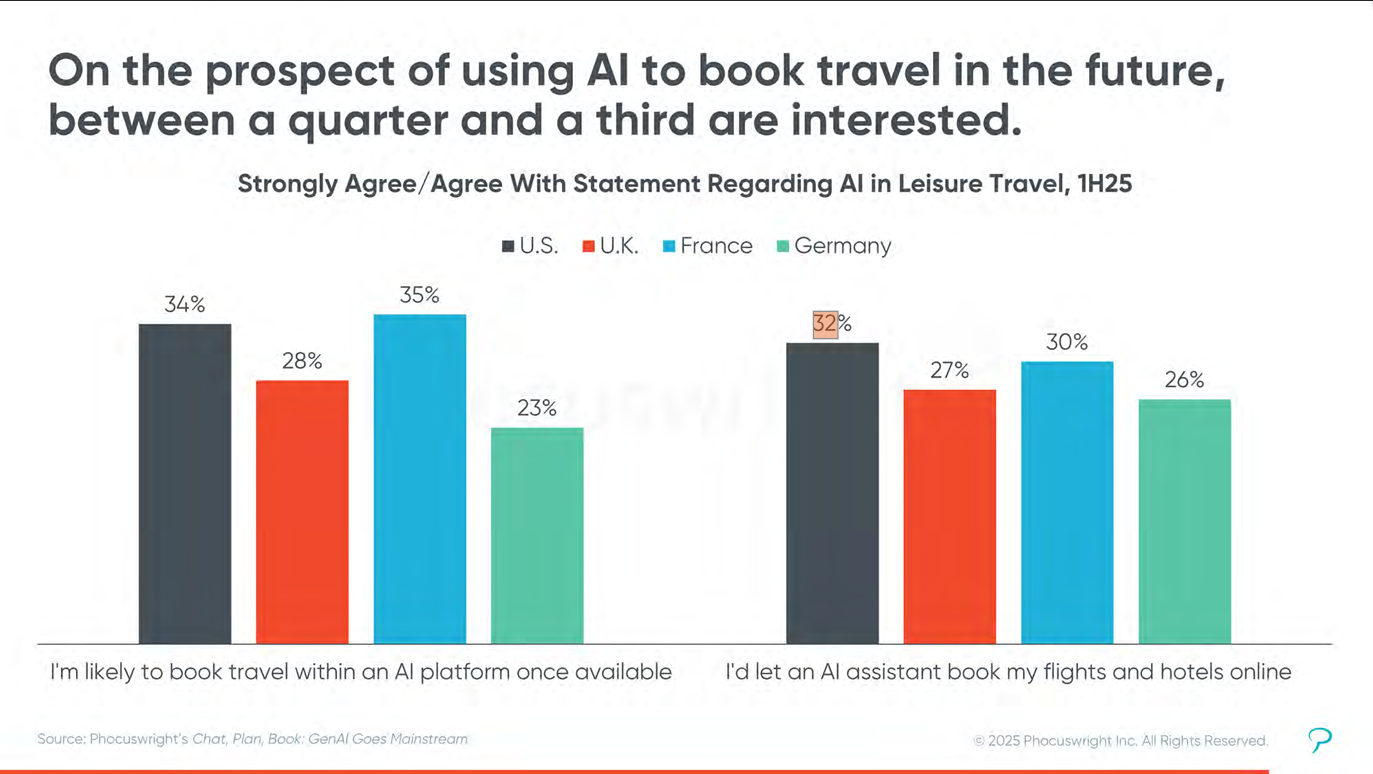
But here's the kicker – and this is what separates the hype from reality. Consumer trust hasn't caught up. Only 2% of travelers say they're willing to give an AI tool full booking autonomy right now (Skift State of Travel 2025, cited in McKinsey & Skift, Sep 2025), although a broader Phocuswright 2025 Year in Review states that around 30% would let AI book flights and hotels. I know this can be overwhelming if you're trying to plan your AI roadmap. It means building agentic capabilities gradually – earning trust through smaller automated actions before asking users to hand over the credit card. We took exactly this approach with Plannin and Trava, and it's the advice I give every travel founder who walks through our door.
Who are the biggest players reshaping AI-powered travel?
The distribution battle in travel is being redrawn by three forces: Google with AI Mode, OpenAI with ChatGPT Apps, and the incumbents racing to stay relevant. This isn't about who has the best chatbot anymore, it's about who controls the transaction when AI becomes the primary interface between travelers and travel inventory.
I've watched distribution power shifts in travel before. GDS systems did it in the 1970s. OTAs did it in the 2000s. Each time, the new intermediary promised to help the industry and ended up owning the customer relationship. We've seen this pattern play out with our own clients – the ones who understood distribution economics early always came out ahead. The question is whether AI agents will repeat that pattern.
Google AI Mode is the player that should concern anyone in travel distribution. In November 2025, Google announced that AI Mode would process flight and hotel bookings directly – not just send users to partner websites (Google Blog, Nov 2025). Partners already on board include Booking.com, Expedia, Marriott, IHG, Choice Hotels, and Wyndham. Flight and hotel booking capabilities are still in development as of March 2026, but restaurant reservations and local service bookings are already live in the US. Google AI Mode already has 75 million daily active users globally (Search Engine Journal, Dec 2025).
Marriott's CEO Anthony Capuano confirmed the partnership on the Q4 2025 earnings call in February 2026: the company is designing a priority search experience to facilitate bookings through AI Mode, with the booking processed directly within the AI interface (Skift, Feb 2026). Marriott plans to invest $1 to $1.1 billion in 2026, with 40% dedicated to digital technology (Phocuswire, Feb 2026).
OpenAI and ChatGPT launched Apps in October 2025, with Booking.com and Expedia as flagship travel partners (PhocusWire, Oct 2025). With over 900 million weekly active users as of February 2026 (TechCrunch, Feb 2026), ChatGPT represents a massive distribution channel that didn't exist two years ago. Accor became the first major hotel group to launch a native ChatGPT app in January 2026, and Hyatt followed in February – reporting measurably higher booking conversion rates and roughly 20% improvement in group sales productivity.
Perplexity launched native hotel booking in March 2025, partnering with Tripadvisor for reviews and SelfBook for managing the process (PhocusWire, Mar 2025) – covering roughly 140,000 hotels from day one (Skift, Mar 2025).
Booking.com has gone deep on AI – AI Trip Planner, Smart Messenger, AI Voice Support, flight search summaries, and a suite of agentic AI tools unveiled in October 2025 (Booking.com, Oct 2025).
And then there's MCP — Model Context Protocol — which is quietly becoming the most important technical standard in travel tech. If you're hearing 'MCP protocol' in travel industry conversations for the first time, here's what you need to know. Originally developed by Anthropic in November 2024, MCP has been adopted by Booking.com, Expedia, Turkish Airlines, Sabre, and Amadeus (Skift, Dec 2025). In November, Turkish Airlines reported €15 million in MCP-driven bookings since July 2025 (Travel Extra, Nov 2025). It is sometimes called an "USB-C for AI agents" – a universal connector that lets any AI system access any travel inventory through a standardized interface.
We've been watching MCP adoption closely because it directly impacts how we architect travel platforms. Every new client conversation in 2026 starts with "are you MCP-ready?"
The implications here are clear. If your inventory isn't accessible via API, if your rates and availability aren't machine-readable, if you haven't thought about MCP – you're building a beautiful storefront on a street that AI agents will never walk down.
What does AI mean for travel distribution and who owns the customer?
Every new technology wave in travel creates a new intermediary that promises to help but ends up owning the customer relationship. GDS did it. OTAs did it. The question isn't whether AI agents will attempt the same, but whether travel companies are prepared to fight for direct relationships this time.
The Harvard Business Review laid this out plainly in January 2026: generative AI is threatening the very platforms that dominate online travel today (HBR, Jan 2026). Conversational AI interfaces bypass the traditional search-and-filter model that OTAs are built on. If travelers start asking ChatGPT to "find me a boutique hotel in Barcelona with a rooftop pool under $200/night" instead of scrolling through Booking.com, the entire gateway model collapses.
But here's the thing – it cuts both ways. At ITB Berlin 2026, the conversation was sharp. As Pedro Colaco, CEO of GuestCentric Systems concluded:
“If AI connects travellers to an OTA checkout, the OTA captures the booking. If it connects to the hotel’s website and booking engine, the hotel captures the value” (Hospitality Net, Mar 2026).
The "digital shelf" – the structured, machine-readable inventory that AI agents can access – is becoming the new battleground. For hotels looking to reduce OTA dependence, this shift creates a genuine opportunity to reclaim direct relationships.
TakeUp AI's January 2026 research makes the urgency concrete: 78% of AI users have booked travel based primarily on AI recommendations, and 84% say a trusted AI recommendation makes them more likely to book a specific property (TakeUp AI, Jan 2026). That's not some theoretical future – travelers are already making real purchasing decisions based on what AI surfaces.
Google AI Mode adds another layer of complexity. Google isn't the merchant of record – partners manage the actual transactions. But Google controls the funnel. And when you control the funnel in travel, you control the economics. As PhocusWire reported in November 2025, hotel and flight bookings are coming to AI Mode. The partners participating early get visibility. Those who wait risk the same fate as hotels that ignored OTAs in 2010 – technically independent, practically invisible.
There's also a fascinating historical parallel worth noting. As Skift pointed out in December 2025, social media never cracked travel booking despite years of trying. They all drove inspiration, but couldn't close the transaction loop. From Skift's perspective, AI might enhance the journey, not replace trusted brands.
Agentic AI faces the same challenge, true, but with a critical difference: AI agents can actually complete transactions. They aren't just inspiring travelers – they're equipped to book. Whether consumers will let them is the open question.
For anyone building or running a travel platform right now, the strategic imperative is this: build your own digital shelf or become invisible. That means APIs, structured data, MCP integration, and machine-readable inventory. Not eventually. Now.
What should travel companies build right now?
I'll be transparent: the companies that will win the AI transition aren't the ones with the fanciest chatbot. They're the ones with clean data, machine-readable inventory, and APIs that AI agents can actually call. If your room rates live in a PDF, if your cancellation policies are buried in paragraph text, if your availability requires a human to check – you're already behind.
Here's what I'd prioritize if I were running your tech roadmap – and this is exactly the framework we use when scoping AI projects at TeaCode:
First: MCP readiness. Make your inventory discoverable to AI agents. Skift's December 2025 analysis was blunt – not being machine-readable will be the fastest way to become invisible in the agentic era (Skift, Dec 2025). Turkish Airlines built their own MCP server and reported €15 million in bookings through it from July to Nov 2025 (Travel Extra, Nov 2025). Lighthouse launched The Hotels Network app in ChatGPT in March 2026 – no commission on bookings, flat subscription fee, built entirely on MCP. This is happening now, not in some theoretical future.
Second: structured data for everything. Rooms, rates, amenities, policies, images, reviews – all of it needs to be available as structured, API-accessible data. This is what the industry now calls the 'digital shelf' – and it's becoming the new battleground for AI-era distribution. AI agents don't read brochures. They parse JSON. If your inventory isn't structured, it doesn't exist to an AI.
Third: internal AI before consumer AI. This trips up more founders than you'd expect. The proven ROI in travel AI is in pricing optimization, demand forecasting, automated rebooking, and customer service triage – not conversational trip planners. Build the operational foundation first. According to Phocuswright, 61% of travel businesses are now experimenting with or scaling agentic AI. At TeaCode, we see the same divide — the ones seeing real returns started with operations, not chatbots.
Fourth: a personalization engine built on context, not just behavior. Past behavior data only gets you so far. We learned this building Plannin's recommendation system: the next generation of travel personalization understands who's traveling, why, and what's happening around them. A business traveler rebooking during a disruption needs completely different AI behavior than a couple planning an anniversary trip. McKinsey's research emphasizes that contextual AI – understanding intent, not just patterns – is what separates good recommendations from ones that actually drive bookings (McKinsey 2025; via FluentSupport).
Whether you're modernizing legacy infrastructure, building MCP server integration, or adding AI personalization to your booking platform — the starting point is a travel technology partner who understands both the AI layer and the business logic behind it.
The build vs. buy decision
This is the question I get most often from travel founders and CTOs: should we build our own AI capabilities or buy them off the shelf?
My honest take: if you're a hotel chain with under 20 properties and no dedicated tech team, buy. Use tools like Alhena for customer service AI, or connect to ChatGPT via The Hotels Network. Don't reinvent the wheel.
But if travel is your core product – if you're an OTA, a booking platform, a travel startup trying to build a moat – you need to own your AI layer. The companies using generic SaaS AI will all look the same to travelers and to AI agents. Custom-built AI connected to your proprietary data is the only path to real differentiation. Not sure which approach fits your travel product? Let's discuss your specific case.
The Plannin case study – what we learned building AI for travel
When we started working with Plannin, we used AI to power content generation and booking personalization for their travel platform. The AI didn't just generate pretty itinerary descriptions – we connected it directly to real inventory data when creating tip boards. That connection between AI output and business logic is what made the difference.
Although it was just one of the features, the results speak for themselves: 70% month-over-month revenue growth and a 38% direct booking rate. Those numbers didn't come from a chatbot widget. They came from AI embedded deeply in the platform's core – personalized content that actually mapped to bookable products.
The lesson I took from Plannin is one I repeat constantly: AI works best when it's connected to your business logic, not bolted on top.
Trava – AI trip planning that actually ships
Trava took a different angle. Their core challenge wasn't individual trip planning, but group travel, where five people with different budgets, preferences, and schedules need to agree on an itinerary. The AI system we helped build uses a voting mechanism backed by ML models that optimize for logistical feasibility and group satisfaction simultaneously.
Trava achieved 30% month-over-month user growth. But the insight that matters more than the growth number is this: the value of AI in Trava wasn't "AI generates an itinerary." Any LLM can do that. The value is "AI resolves group conflict by finding itineraries that satisfy competing constraints." That's a genuinely hard problem, and it's the kind of problem where custom AI outperforms any generic tool.
What's the real AI adoption timeline in travel?
AI adoption in travel compressed a decade of change into three years. In 2022, only 4% of top travel firms mentioned AI in annual reports. By 2024 — 35%. By 2026, 61% are scaling agentic AI systems and Marriott has integrated Google AI Mode for direct booking. The companies I've worked with confirm what the data shows: the acceleration from 2024 onward has been unlike anything the industry expected.
The trajectory is clear, but the pace matters. IDC projects that a significant share of travel bookings – potentially 30% or more – will be executed by AI agents by 2030 (IDC, 2026). That sounds far away, but the infrastructure decisions you make in 2026 determine whether you're part of that future or invisible to it.
What's hype and what's real – an honest assessment?
Let me flag something that most AI-in-travel articles won't tell you: the gap between industry excitement and consumer readiness is enormous. The industry is building for a future that consumers haven't signed up for yet. And I say this as someone who builds AI travel products for a living – I have skin in this game, and I'm still cautious.
Gareth Williams, co-founder of Skyscanner, put it bluntly at a Skift event in March 2026: "I've been really struck by how negative the public is towards AI compared to people inside the industry" (Skift, Mar 2026). That's the co-founder of one of the world's biggest travel search engines saying the industry may be overestimating consumer appetite.
And just weeks after Williams' warning, Expedia Group published the data to back it up. Their April 2026 "AI Trust Gap" report — surveying 5,700 travelers across the US, UK, and India — found that 66% would not trust an AI assistant to make any purchase on their behalf, and only 8% feel comfortable booking through an AI platform like ChatGPT and Gemini (Expedia Group, Apr 2026). The gap we identified earlier — 91% plan vs 2% book — is now confirmed by independent research from one of the largest OTAs on the planet. This isn't a fringe finding. It's the consensus.
The numbers tell a layered story. Awareness is at 90%+. Active usage of AI for trip planning activities is at 38% and growing fast (TakeUp AI, 2026). But autonomous trust – letting AI book without human approval – sits at just 2% (Skift State of Travel 2025, cited in McKinsey & Skift, Sep 2025). Meanwhile, 94% of AI users say they trust AI recommendations at least as much as traditional sources, but only 25% trust AI more (TakeUp AI, 2026). I call it the AI booking trust gap — and every decision you make about your travel AI roadmap should account for it.
Then there's the hallucination problem. CNBC reported in March 2026 on ChatGPT suggesting a Paris driving route that completely ignored known road closures. Smaller businesses without a strong digital presence risk becoming invisible to AI entirely – if your hotel isn't in the AI's training data or accessible via API, it effectively doesn't exist.
And here's the reality check that sobered up the whole industry: when the Middle East airspace crisis erupted on February 28, 2026, over 43,000 flights were cancelled. Most travel companies routed affected passengers to overwhelmed human agents – not their marketed AI systems. Skift reported on March 13 that AI was largely absent during the most critical operational test of the year. That gap between marketing promises and operational reality is something every travel company needs to confront honestly.
That sounds like a lot of bad news, and I know this can feel discouraging. But the opportunity is real. The trust gap will close – it always does with new technology. What matters is whether your infrastructure will be ready when it does. We're helping our clients build MCP integration, structured data layers, and internal AI operations today specifically so they can capture the agentic booking wave when consumers finally trust it enough to let go.
FAQ – Frequently Asked Questions
What is agentic AI in travel?
Agentic AI in travel refers to AI systems that autonomously plan, book, modify, and manage travel arrangements without requiring step-by-step human input. Unlike traditional chatbots that answer questions, agentic AI makes independent decisions, calls external APIs for real-time pricing and availability data, and executes multi-step tasks – like rebooking disrupted flights, finding alternative hotels near a rescheduled connection, and updating the full itinerary. McKinsey and Skift defined agentic AI in their September 2025 report as systems with autonomous decision-making, multi-step reasoning, external tool access, and persistent memory across sessions.
How is AI being used in the travel industry in 2026?
AI in travel in 2026 is primarily used for operational tasks with proven ROI: dynamic pricing optimization, demand forecasting, customer service automation, automated rebooking during disruptions, and personalized recommendations. 59% of travel executives credit AI with measurably boosting productivity, according to the McKinsey and Skift 2025 survey of 86 industry leaders. Consumer-facing applications like Booking.com's AI Trip Planner and Google's AI Mode are scaling rapidly, but fully autonomous booking remains experimental. The most successful travel companies started with internal AI operations before building customer-facing features.
What is Google AI Mode and how will it change travel booking?
Google AI Mode is an AI-powered conversational search experience that lets users research, plan, and will eventually book travel directly within the search interface. It has 75 million daily active users globally as of December 2025. Partners already building integrations include Booking.com, Expedia, Marriott, IHG, Choice Hotels, and Wyndham. Flight and hotel booking capabilities are still in development as of mid-2026 – though restaurant reservations and local service bookings are already live in the US. Marriott's CEO confirmed the integration on the Q4 2025 earnings call.
What is MCP (Model Context Protocol) and why should travel companies care?
MCP is an open standard developed by Anthropic that lets AI agents connect to external data sources and services through a universal interface – it is sometimes called an "USB-C for AI agents." For travel companies, MCP means making your inventory – rooms, rates, availability, policies – accessible to any AI agent from ChatGPT to Google AI Mode through a single integration rather than building custom connections for each platform. Turkish Airlines built their own MCP server and reported €15 million in MCP-driven bookings from July to November 2025. Booking.com, Expedia and Sabre have all adopted MCP. Not having an MCP server is becoming the fastest way to become invisible to AI agents.
Can AI actually book flights and hotels autonomously?
The technology exists, but consumer adoption is extremely low – only 2% of travelers currently trust AI to book without human oversight. Sabre, PayPal, and Mindtrip announced the travel industry's first end-to-end agentic booking system in February 2026, with Mindtrip Flights going live in May 2026 via Sabre's Mosaic APIs covering 420+ airlines and 2 million+ hotels (OAG, 2026). The technical capability is here, and multiple platforms are racing to deploy it. But the consumer trust gap remains the bottleneck – which is why I recommend travel companies focus on building the infrastructure now while earning trust through lower-stakes AI interactions like rebooking and recommendations.
How does AI personalization work in travel?
Modern AI personalization in travel goes beyond basic behavioral data like past bookings and search history. It incorporates real-time contextual signals – who's traveling, the purpose of the trip, group dynamics, budget constraints, time of year, and even external factors like weather and local events. McKinsey's 2025 research emphasizes that contextual AI – understanding intent, not just patterns – is what separates good recommendations from ones that actually drive bookings. When we built Plannin's personalization engine, the breakthrough came from connecting AI recommendations to real inventory data, not just generating appealing descriptions.
What percentage of travelers use AI for trip planning?
According to Klook's Travel Pulse 2026 survey of 11,000 consumers across 20 countries – primarily Millennials and Gen Z on digital travel platforms – 91% of travelers use AI as a trip planning tool for research, destination discovery, itinerary creation, translation, and budgeting. Separately, TakeUp AI's January 2026 survey of 300 US leisure travelers found that only 38% have actively used AI for trip planning. And according to Skift's State of Travel 2025 survey, only 2% trust AI with full booking autonomy – revealing a clear progression: awareness → experimentation → trust → autonomy.
Will AI replace OTAs like Booking.com and Expedia?
Not directly, but AI is fundamentally reshaping their role. HBR argued in January 2026 that conversational AI threatens the search-and-filter gateway model OTAs rely on. However, OTAs are adapting aggressively – Booking.com is one of the most advanced AI adopters in travel, with native ChatGPT and Google AI Mode integrations. The more likely outcome is that AI fragments the distribution funnel: some travelers book via Google AI Mode, some via ChatGPT, some direct, and OTAs become one channel among many rather than the dominant gateway. Hotels that build their own digital shelf through MCP integration could reclaim direct relationships.
How can hotels become visible to AI search agents?
Hotels need to build a "digital shelf" – machine-readable, API-accessible inventory that AI agents can query in real time. This means structured data for rooms, rates, amenities, and cancellation policies available as JSON or via API rather than PDFs or brochure text. MCP server integration is becoming essential – Lighthouse launched The Hotels Network app in ChatGPT in March 2026 offering commission-free booking built on MCP. Hotels should also ensure presence in AI travel platforms like ChatGPT Apps and Google AI Mode, maintain strong structured data markup on their direct website, and keep pricing data consistent across all channels so AI agents serve accurate information.
What's the difference between AI chatbots and agentic AI in travel?
Chatbots are reactive – they answer questions within predefined topics and reset after each conversation. Agentic AI is proactive – it takes initiative, remembers context and preferences across sessions, calls external APIs for real-time data, and executes multi-step transactions autonomously. A chatbot tells you flight options when asked. An agentic AI monitors your booking, detects a cancellation, finds alternative flights that match your preferences and schedule, rebooks you, locates a hotel near the new connection, and sends you a consolidated update – all while you sleep. The architectural difference is that agentic systems have persistent memory, tool access, and decision authority that chatbots lack.
How much does it cost to add AI features to a travel platform?
Costs vary dramatically based on scope and approach. Off-the-shelf AI integrations like chatbot widgets or recommendation plugins typically range from $5,000 to $50,000 to implement, with ongoing SaaS subscription costs. Custom AI development – personalization engines, agentic booking systems, MCP server integration – typically starts at $50,000 for an MVP and can exceed $250,000 for enterprise-grade systems with full data pipeline integration. The build-vs-buy decision is critical and depends on whether AI is a core differentiator or a supporting feature for your business. We break down the full cost landscape in our travel app development guide.
Is AI in travel overhyped?
Partly – and I say this as someone who builds AI travel products professionally. The consumer-facing, autonomous booking side is ahead of consumer readiness: only 2% trust AI to book autonomously, yet the industry is investing billions in agentic capabilities. Skyscanner's co-founder Gareth Williams openly noted in March 2026 how negative consumers are compared to industry insiders. But the operational side – pricing optimization, demand forecasting, customer service automation, rebooking – is delivering measurable ROI today across many major travel companies. The hype is in the timeline, not the direction. AI will reshape travel distribution. It just won't happen as fast as keynote speakers want you to believe.
What AI tools are airlines using right now?
Airlines are among the most advanced AI adopters in travel because operational complexity and disruption costs make the ROI case compelling. Current AI applications include dynamic pricing optimization across thousands of routes, demand forecasting for capacity planning, automated disruption management and passenger rebooking, predictive maintenance for fleet operations, customer service automation handling tier-1 queries, and fraud detection for payment processing. Turkish Airlines built its own MCP server for direct AI agent integration and reported €15 million in MCP-driven bookings over a few months.
How is Booking.com using AI?
Booking.com has one of the most advanced AI implementations in travel, built in close partnership with OpenAI. Their current AI suite includes: AI Trip Planner for conversational search and trip planning, Smart Messenger handling tens of thousands of the 250,000+ daily customer messages with a 73% increase in partner satisfaction, AI Voice Support for hands-free trip management, flight search summaries for quick comparison, review summarization, Property Q&A, and Smart Filters. In October 2025, they launched a suite of agentic AI innovations – their first in-house agentic systems. Booking.com is a launch partner for both Google AI Mode and ChatGPT Apps, positioning them at the center of the AI distribution shift.
Should travel startups build or buy AI capabilities?
It depends on your core business and competitive strategy. If travel is your product and AI is a potential differentiator – build custom. We see this clearly in our work: companies using generic SaaS AI end up with the same features as every competitor, which means zero competitive moat. Custom-built AI connected to proprietary data is the only path to real differentiation. But if travel is adjacent to your business (a hotel chain, a regional agency, a tour operator) buying SaaS tools like Alhena for customer service or connecting to ChatGPT via The Hotels Network makes more sense. Either way, invest in structured data and MCP readiness first – that infrastructure supports both approaches.
What is the AI booking trust gap in travel?
The AI booking trust gap describes the disconnect between how many travelers use AI for trip planning (91% according to Klook's 2026 survey) and how many trust AI to actually book (just 2% per Skift's State of Travel 2025). Expedia's April 2026 report confirmed the pattern: 66% of travelers won't trust AI to make purchases on their behalf, and only 8% feel comfortable booking through an AI platform. The gap exists because travel is high-stakes — a wrong hotel or missed flight has real consequences. Closing this gap requires earning trust through lower-stakes AI interactions before asking users to hand over booking autonomy.
How is MCP different from a standard API integration?
A standard API integration is point-to-point — you build a custom connection between your system and each AI platform separately. MCP is a universal interface: one integration that makes your inventory accessible to any AI agent, from ChatGPT to Google AI Mode to Perplexity. Think of it as the difference between building a separate charger for every phone versus adopting USB-C. Turkish Airlines built one MCP server and it worked across all AI platforms, generating €15 million in bookings from July to November 2025. For travel companies, MCP means building one connection instead of maintaining dozens.
The 89-point gap will close – will you be ready?
Let's come back to where we started. Ninety-one percent of travelers use AI. Two percent trust it to book. That gap – 89 points of unresolved trust, accountability, and technical readiness – is the defining challenge and the defining opportunity in travel tech right now.
The gap will close. It always does. Email was "too impersonal" for business. Online payments were "too risky" for travel. Mobile booking was "too small a screen." Each time, the skeptics were right about the frictions and wrong about the timeline. The same will happen with agentic AI in travel.
But here's what the skeptics miss: by the time consumers are ready, the infrastructure needs to already be there. MCP integration doesn't happen overnight. Structured data migration takes months. Building an AI layer connected to your actual business logic – not just a chatbot skin over a generic LLM – takes real engineering and real time. Six to twelve months, minimum, for anything meaningful.
The companies that build now will own the distribution when agentic AI goes mainstream. The companies that wait will find themselves invisible to the AI agents that are booking travel on behalf of a significant share of consumers by 2030.
We built Plannin's AI-powered booking platform that drove 70% month-over-month revenue growth. We built Trava's group trip planning AI that resolves competing preferences through ML-backed optimization. If you're planning AI features for your travel product – whether that's conversational search, personalization, custom booking app development, or MCP integration – let's talk. Our team has shipped all of these
The trust gap is temporary. The infrastructure gap might not be.
This article was originally published on
November 25, 2024
July 2, 2026

By subscribing you agree to receive information from TeaCode about software development, the company and its projects to your email. Your data is processed by TeaCode to send you relevant content via newsletter. You can unsubscribe at any time. You can read more in our Privacy Policy.
.webp)
